
- News
- City News
- bhopal News
- Think-tank report on suicide a wake-up call
Trending
This story is from February 12, 2018
Think-tank report on suicide a wake-up call
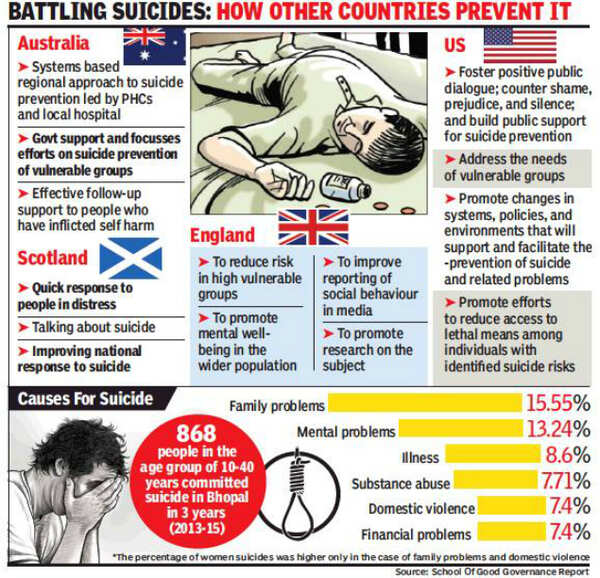
A report by the Atal Bihari Vajpayee Institute of Good Governance and Policy Analysis, a Bhopal-based think tank, in a way, indicate a swift action before it gets too late. The report— ‘suicide prevention strategy framework for Madhya Pradesh’— “MP with a population of over 7 crore has just 15 psychiatric doctors in government hospitals, as opposed to 700 mandated in the National Health Mission (NHM).”
Experts also strongly feel there is an urgent need to put in place a good health infrastructure in the state sooner than later.

The report that takes into account causes and demography of suicides in Bhopal in 2013, 2014, 2015 and 10 months of 2016, studies and covers data from 34 police stations in the state capital. “Suicide is one of the three leading causes of death in economically productive age group (15-44 years) and second major cause in 15-19 years,” reads the report.
It highlights youth in the age group of 20-30 years are most vulnerable category. Men are more vulnerable than women. “Youth in age group of 10-40 years comprise 60% of total suicide cases. Private job holders, housewives, labourers and students form the high-risk category. Family and mental problems, diseases and financial problems were major causes of suicide,” the report states.
The study shows there is a consistent increase in number of suicides among men, a trend in keeping with the global phenomenon. Demographic profile of victims also indicates there is a strong tendency among youth to commit suicide.
“Except for Indore medical colleges, no other government-run medical institute has introduced PG course in clinical psychiatry in the state. There are no courses for clinical psychology in any medical colleges of state,” reads the report. There is no helpline for suicide prevention in MP, the report points out.
At present, MP has two psychiatric hospitals — Mansik Arogyasala and psychiatric hospital in Indore. On Saturday, Union minister Thawar Chand Gehlot announced a psychiatric rehabilitation centre with ‘world-class’ facilities would be set up soon in Bhopal.
The study also lists a framework for suicide prevention in Madhya Pradesh based on findings. The approach adopted follows three phases— identification, intervention and mainstreaming.
The major steps talk about identifying triggers for suicide. “Research across the world suggests existence certain risk factors or pre-disposition, which might precipitate into a crisis,” reads the report. The causative factors can be individual (mental disorder, substance abuse), socio-cultural (stigma associated with talking about problems) or situational (failure in exams, financial problems). This apart, the target group needs to be identified for intervention. Mainstreaming revolves around removal of stigma.
Dr Satyakant Trivedi, a psychiatrist, who is spearheading a campaign to include mental health in school curriculum, says, “Suicides can be prevented if a stigma around mental health is removed. Mental health facilities in India and the state need a lot of improvement. The facilities should be made accessible to all strata of the society.”
End of Article
FOLLOW US ON SOCIAL MEDIA









Photostories

Hot Picks
TOP TRENDING
Popular Categories
Hot on the Web
Top Trends
Lawrence BishnoiIND vs NZ Live ScoreGautam GambhirSajid KhanYahya SinwarTaylor SwiftMS DhoniJEE Main Exam PatternUKPSC Recruitment 2024Justin TrudeauFlights Bomb ThreatWho is Vikash YadavMaharashtra Election 2024US Presidential Election 2024Maharashtra Election ScheduleJharkhand Election ScheduleLive Cricket Score
Trending Topics
Diwali WishesDhanteras 2024Fake PaneerRadhika MerchantsSomy AliVicky Vidya Ka Woh Wala Video CollectionLawrence BishnoiAkash AmbaniAvinash MishraBigg Boss 18Kaun Banega Crorepati 16Shraddha KapoorVettaiyan CollectionBougainvillea Movie CollectionJuhi ChawlaLiam PayneTop Load Washing MachinesBest Premium LaptopsIntel LayoffsWordle Answer
Living and entertainment
Latest News
Karnataka NEET UG 2024 mop-up round provisional allotment withdrawn by KEA, revised result to be issued today: Check details hereWhen Deepika Padukone opened up about fame and money in Bollywood; Says, 'It’s easy to get carried away'Taylor Swift plans tribute to Liam Payne after his tragic death during final Eras TourVijay's 'Kaththi' and 'Mersal' re-release postponed'We are all on the same team now': Senate minority leader Mitch McConnell defends past remarks on Donald TrumpKing Charles III's first visit to Australia reignites debate on ending ties to British monarchyBigg Boss Tamil 8: VJ Vishal teases Dharsha Gupta over her Cooking, sparks emotional outburst'Unlikely I am going home': Bangladesh's Shakib Al Hasan on playing farewell Test in MirpurKartik Maas 2024 Start and End Date: Time, Puja Rituals and SignificanceStudent kills self in Kota, 15th this yr7 deadliest reptiles in the world from venomous snakes to turtles'Aaqib bhai, Pakistan cricket ko kya ho gaya?' Gautam Gambhir asked - Watch'Jigra' box office collection day 7: The Alia Bhatt starrer sees a further drop in numbers as it completes its one week run, inches closer to Rs 25 croreFukrey's Manjot Singh regrets losing out Sushant Singh Rajput's Chhichhore: Felt bad when it didn't happen (Exclusive)HC raps NMC for letting 'consistent defaulter' college admit studentsHow does Google track your location without GPS and how to stop itJessi comes out after six hours of interrogation; the new victim alleges a similar assault incidentNokia is cutting 2,000 jobs in China, and how this 'Huawei ban' may be the reason
Copyright © 2024 Bennett, Coleman & Co. Ltd. All rights reserved. For reprint rights: Times Syndication Service